
Language is like a virus, it can spread, it can modify its hosts, and there's not much one can do to fight it. However, this virus is a blessing. At least it is for me, once I became aware of the impact of language for the human species, but particularly, for me. (I later found out Dawkins had a name for this — I'll be reading his work soon).
When did I become aware of the fact that a language could shape the way I understand things? It was very recently, when I started learning Ukrainian. My Ukrainian teacher Oksana, told me that learning Ukrainian was going to shape my brain. She was right.
But let's take a step back, and trace my language learning path. Of course, since it's been a long time since I learned some of those, my memories can be very blurry, but it doesn't really matter. Because I'm typing this in English, the second language I learned, and the language that took over my thoughts. So, I don't know if these memories are accurate or not because they happened in "Spanish", but I'm retrieving them in "English". At least consciously. Some of them might be stored in my brain in one language, retrieved in another, and translated to English as I type.

My mother tongue is Spanish, particularly, Spanish from Mexico City. I have almost no recollection about how I learned it, and at what age. But as an adult, I feel very sure that it was by being exposed to adults who spoke Spanish. My parents and family. Down the road, at school. I remember learning to write during my primary school years, and Spanish was how I consumed the world: TV, conversations, books, magazines, etc. So Spanish shaped my early thoughts.
English came through video games, not school. Back in the 90s. Most games in Mexico were imported from the US, and they were not localized into Spanish. So, the way I learned English was some sort of pattern-matching algorithm, were a game would render some text: "Press A to jump". And then, after some trial and error, I would see a character jump, once I pressed A, so I suppose my brain started connecting those words with actions. I do remember that this was not easy, there were games, that I played and finished without fully understanding the dialogues, or the instructions. I then continued consuming more and more English content: movies (with subtitles), music (CDs used to come with booklets and lyrics, later on the internet had lyrics online), books, more games, code, magazines, and more games.
I did study English for most of my school year, but I never felt I could "speak English". It was until I joined Unity, that I got exposed to English in the real life. Colleagues, customers, friends, English was the way to communicate.
When did I notice that my brain switched from "thinking in Spanish" to thinking in English? I realized this once I moved to the US. Even when Austin has a lot of Spanish speaking people, most of work, and my network communications happened in English. From everyday activities, to social activities, to medical, and financial. At one point, I realized my thoughts happened in a different language. English.
Portuguese I never planned for. During my time at Unity, I probably traveled to Brazil 20 or 30 times. For most of my professional interactions, communications happened in English, but for the rest, I was surprised about the Portuguese language, about the closeness to Spanish (I could understand most of it, it was more difficult to speak without mixing Spanish words. There's a term for this; Portuñol). It really didn't take long to get the language. But once I could communicate in Portuguese with people in Brazil, I realized I was able to see a world, close to mine, but different.
Why did I start learning? Love. Why do I continue? Because every new thing I learn, unlocks a new window to the world, to my mind, to the mind of others. And granted, I can't really know what's in other people's minds. However, it has been a wonderful tool to see more, to experience more, and to feel more. The way I'm learning, is structured, and I realized that the way I learned, and people learn their first language, is different than the second, third or fourth. I always ask: "do kids know all this"? And the answer is no. Kids learn by repetition, pattern matching, and when their brain is different. As an adult, the way that has worked for me, is to use algorithms, rules, and frameworks. Ukrainian is for sure different than English and Portuguese, starting from the characters they use, the Cyrillic set.
The .ZIP of Ideas
Languages are a way to compress information. If I tell my girlfriend "Я кохаю тебе". I'm compressing feelings, a cultural (western) idea of romance, and a summary that given the context, means I don't say this to anyone else. However, I say that because that's the closest concept in Ukrainian, that I can match to my Spanish "Te Amo". I don't think that the "I love you" in English, really expresses the same feeling as it does in Spanish. Maybe I can only love in Spanish? Then she decompresses them into what her Eastern-European concept of love is. And the more we talk about these topics, I realize that this compression is lossy, however, even if we spoke the same language, and we were monolingual, language would still be a compression of whatever our neurons are firing in our brains.
Extra Ears, Extra Eyes, and Extra Senses
Imagine if you suddenly grew an extra pair of eyes at the back of your head, you now could see things that you previously could not. Maybe even a close to 360-view power. In the case of extra eyes, people might notice them, but with languages, is like extending your senses without anyone really being able to know, unless you decide to show.
And what can you sense with these new senses? You get access to more knowledge, to new relationships. For example, with Portuguese, I'm now able to listen to Xadrez Verbal, a podcast I love about news. I don't listen to any news, but the Xadrez Verbal team makes it enjoyable for me. I was able to watch Irmao Jorel, in the original language, which is a lot of fun, and while it also has a dubbed version, it is just different, it has opened my curiosity to learn more about Brazil, the Brazilian people and their culture. Speaking of relationships, thanks to Portuguese, I was able to meet people who otherwise would not be able to meet with because there was no other common language we could speak, I got to see how their life is, how their world perception was shaped, their past. Mostly, people who drive taxis, people at the markets, people at coffee shops. This is something that otherwise would have been locked from me.
English of course, has opened up the world of knowledge. The internet; Wikipedia, Twitter, YouTube, most of the content related to what I do professionally is written in English. Some of it gets translated, but it takes time, and by the time it makes it to a different language, might be too late and the technology might be outdated. Books, again, most of it is in English. I'm sure there's also knowledge hidden in other languages like Chinese, Japanese, Hindi. I could buy a book and feed it into an LLM to translate it, but even the process of discovering that book is something that knowing the language alone can unlock. Understanding English is a huge advantage. Not knowing it is an equally big one to carry.
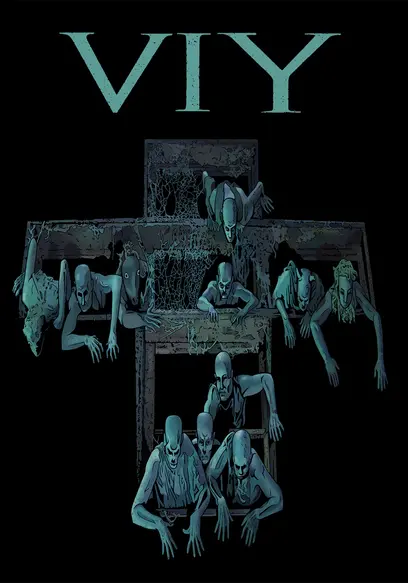
Ukrainian opened up art and culture, and most importantly, it modified my mind. I rarely listen to music, but Ukrainian music hits different. Maybe people who think they don't like music just haven't found music that was encoded for them; not necessarily in lyrics, but in the way it was built, its rhythm, its emotional register. Similar to how we like certain genres and not others. Козаки, a cartoon, was another window — a way to see a world shaped by completely different stories than mine. And then there's Viy, a 1967 Soviet horror film based on a Gogol story: Ukrainian put it on my map, and I'm glad it did. Without that curiosity the language opened in me, I'd never have gone looking. And I don't mean just the content, but the way that content is encoded, using their language, with their strengths and weaknesses.
Stories
The single thing that allowed us humans to have agreements at scale has been the creation of stories, myths. Can be religions, nations, books, movies, games, social media. That's a way to let us have a common goal. A way to organize, and to have common values, laws, and rules. These stories also shape our culture, personality, sense of good or bad, and I think also the way we feel. In any case, these stories are possible thanks to language. A painting can express things too, but it would be hard to align millions of humans behind just one.
These stories are the prime way the "language" virus expands. And while in some cases might be easier to track how — kids learning the history of their country at school — others might be very difficult. Maybe you read a quote in a book, forgot about it, but now that quote guides your life in a way you don't fully understand. Honestly, I hope a lot of humans know that our reality is mostly a big story, one that someone told us, or one that we invented ourselves.
But to me, new languages allowed me to access new stories. Stories told by people who lived different lives than mine, from places far away from where I live. And most of the time, they contradict my beliefs.
My beliefs were early shaped by Mexican-Latin-Catholic stories. As I grew up, American culture took over, mostly via games. Japan had a big influence too, but since the language was still English, those Japanese stories were filtered into a framework closer to mine. Portuguese then came in, and allowed me to read authors similar to my frame of reference, but who expressed themselves differently.
The big surprise again, was Ukrainian. Those stories, when read in Ukrainian, are narrated from a perspective unlike anything I have experienced before. This, to me, has been a big realization: the power of stories, and language, to understand and be understood.
Languages, Programming Languages
So far, I've explored the spoken/written languages, but I acknowledge there are other kinds: mathematical, visual, and programming languages. I honestly don't know where to draw a line to define which one is which. And I don't think it matters, what matters is that each new language, the more different it is from the other, can unlock new ideas. And maybe screws up others. I'm sure there are drawbacks, but I'm less concerned about those for now.
Anyway, as an engineer, there's another language type that I think about almost daily. That's the programming language, a way for us humans, to communicate with computers, in a high-level abstraction that is close to the languages we are used to use.
Throughout my life, I've used many programming languages, to very different degrees of exposure to them: ASM, C, C++, C#, JAVA, JavaScript, Python, Erlang, Ruby, PHP, SQL, Brainf*ck, Objective-C. Many of them use a similar paradigm (Object Oriented, Functional, Structured), and even within the same paradigm, each language offered differences that made me change how I could speak to computers. In some cases, the language was more useful for asking a computer to get me some data: SQL. In others, it was easier to map an object that exists in real-life: a car, to a computer represented version of it in a game: a car gameobject: C#.
But languages like Erlang, have a special place in my heart/mind. Because the way they work, is closer to how I imagine it is to speak to an abstract being, just talking in functions. Using recursion heavily. ASM is as close as I could be to talk to a computer directly, but it was too difficult to really be productive.
Each language, piece by piece, molded my brain and allowed me to abstract patterns useful for communicating with computers. Programming languages were a conscious jump into a new way of communicating — I could now talk to a machine, influence it, tell it what to do. But it was one direction. With LLMs, that changed. Now the machine talks back. And if language is a virus, this is the first time the computer can infect me back.
Natural Language ... Models
I wish I could remember how I discovered ChatGPT, but I remember the first conversations were a lot of fun. Being able to speak to someone, at a pace that was mine, and felt like there were no risks in asking something incorrect, or boring, or stupid. I always knew that there was not a human on the other end, however, the way the written language was being created in almost real-time, was amazing. Most of my early interactions with ChatGPT were asking questions, similar to how I used to work with the Google search engine, later on, we've got to have deeper conversations about life.
One key distinction. With LLMs came the opportunity to learn how a machine uses language, and while we are far from fully understanding it, language as a shared output is a window into how both work. I don't say that machines and humans work the same way, but if language is an output for both, there are ideas we can share to understand them, and understand us.
I've spent the past five years looking into AI, specifically LLMs and computer vision. Just for the admiration of them. I might revisit this section in a few years, once we know more about us, about other beings we share the world with, and with machines.